



Marie-Curie Actions at the EU


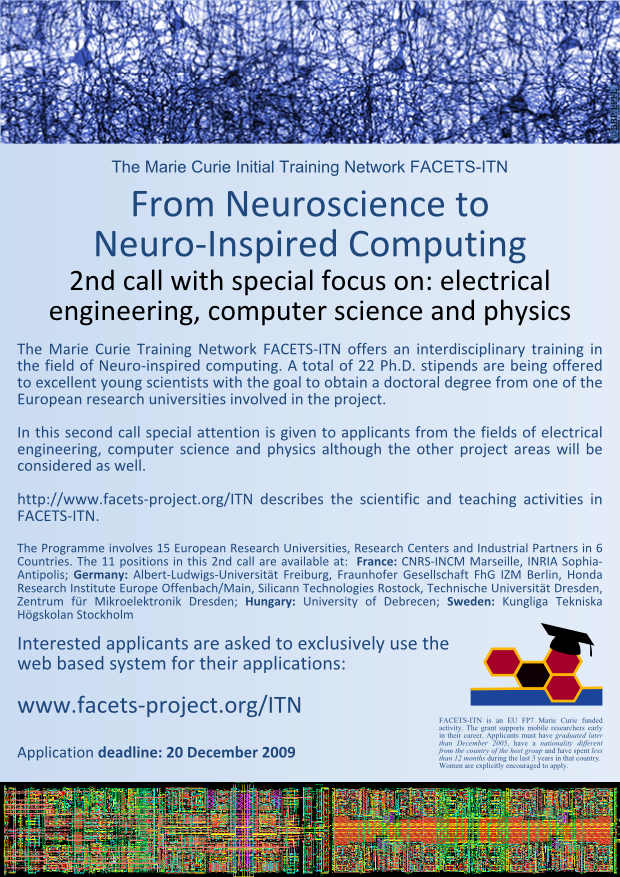
The second-round application poster.

FACETS-ITN Ph.D. positions: From Neuroscience to Neuro-Inspired Computing

22 Ph.D. Positions are funded in the FACETS-ITN project in the following scientific work areas: Neurobiology of Cells and Networks, Modelling of Neural Systems, Neuromorphic Hardware, Neuro-Electronic Interfaces, Computational Principles in Neural Architectures, Mechanisms of Learning and Plasticity.

This 'Marie-Curie Initial Training Network' (funded by the EU) involves 15 groups at European Research Universities, Research Centers and Industrial Partners in 6 countries.

Ph.D. students will participate in an exciting research programme and will receive a strongly interdisciplinary training in all scientific areas involved as well as in additional skills (planned training workshops). The program also includes extended stays in several partner laboratories (about 4 months in 2-3 different locations). Ph.D. degrees will be awarded by the universities of the partner groups. Each position is funded for up to 3 years.

Applicants with an excellent degree (Master of Science, Diploma, earned since September 2005) in Biology, Physics, Computer Science, Engineering or Mathematics and the strong wish to actively contribute to an interdisciplinary research activity are invited to apply. This second application round is open until end of December 2009. The selection committee will meet early January 2010.

(The first application-round closed on 26 August 09. 11 of the FACETS-ITN Ph.D. positions -- especially in the area of electrical engineering, computer science and physics -- are not yet filled.)


Research Areas

  • Area I: Neurobiology of cells and networks
  • Area II: Modelling of Neural Systems
  • Area III a: Neuromorphic Hardware
  • Area III b: Neuro-Electronic Interfaces
  • Area IV: Computational Principles, Learning and Plasticity

While each thesis has a primary scientific area, it is explicitly envisaged that the thesis projects bridge the gap to at least one of the other work areas.

Examples for thesis topics

France
CNRS-INCM (1)
Marseille
  • Theoretical study of dynamical mechanisms for motion integration and segmentation
  • Large-scale neural networks for optimal image processing: from software to hardware implementation
INRIA (2)
Sophia Antipolis
  • Bifurcations in neural fields models.
  • Mean field techniques in neural field models.
Germany
ALUF (2)
Freiburg
  • Joint theoretical and experimental study of input selectivity in V1
  • Modelling dynamics in multi-layered column: spiking neural networks vs. rate models
  • Modelling computation with synchrony embedded in large cortical network models.
FHG* (1)
Berlin
  • Development of an ultra high-density Wafer Level Metallization for fast analogue computing.

Partner university is UHEI.

HONDA-RI* (1)
Offenbach
  • Learning of hierarchical object representations and top-down processing in thalamo-cortical network models

Partner university is ALUF.

SILICANN* (1)
Rostock
  • Analysis and implementation of real-time serial communication circuits for neuromorphic VLSI and for general high-bandwidth digital designs.

Partner university is TUD.

TUD (1)
Dresden
  • Applying neural simulations and benchmarks to neuromorphic hardware: issues, strategies, comparative analysis of soft- and hardware realizations.
  • Analysis and development of mixed-signal & neuromorphic VLSI with emphasis on communication components for the FACETS waferscale system.
ZMDI* (1)
Dresden
  • Analysis and Compensation of VLSI process variations in mixed signal & neuromorphic circuits to achieve reproducible behaviour with respect to the corresponding behavioural model.

Partner university is TUD.

Hungary
UD (1)
Debrecen
  • Mapping of synaptic input to dendrites in the visual cortex.
  • Model based analysis of horizontal neuron networks underlying image segmentation and contour integration
Switzerland
EPFL-LCN (1)
Lausanne
  • Synergistic effects during consolidation of synapses.
  • Reward-based learning in plausible synapse models.

The table shows the partner groups (with number of available ITN funded Ph.D. positions) and possible Ph.D.-thesis topics. Partners marked with a * are industrial or semi-industrial partners.


. 
 

16 Nov 2009