




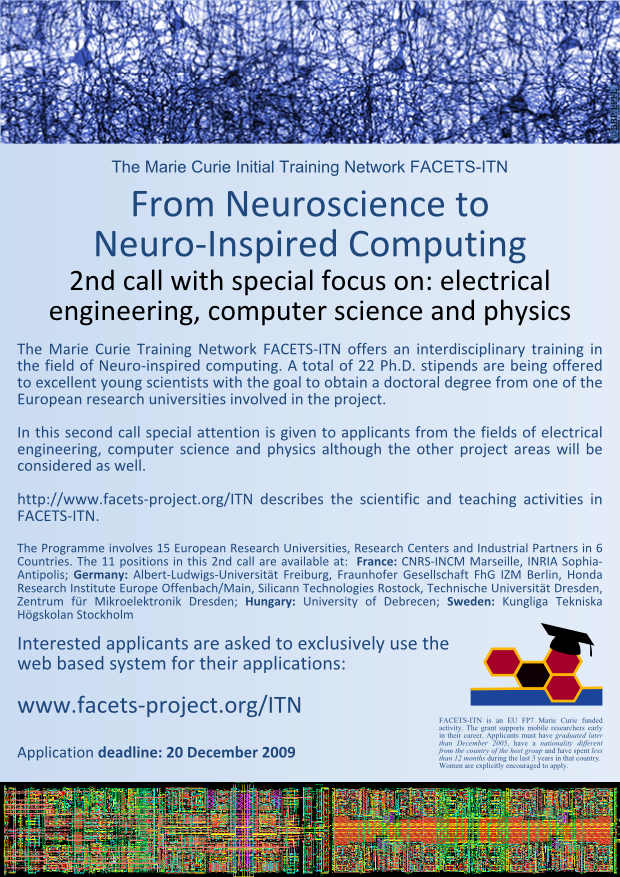
Marie-Curie Actions at the EU


The second-round application poster.

FACETS-ITN Ph.D. positions: From Neuroscience to Neuro-Inspired Computing

22 Ph.D. Positions are funded in the FACETS-ITN project in the following scientific work areas: Neurobiology of Cells and Networks, Modelling of Neural Systems, Neuromorphic Hardware, Neuro-Electronic Interfaces, Computational Principles in Neural Architectures, Mechanisms of Learning and Plasticity.

This 'Marie-Curie Initial Training Network' (funded by the EU) involves 15 groups at European Research Universities, Research Centers and Industrial Partners in 6 countries.

Ph.D. students participate in an exciting research programme and receive a strongly interdisciplinary training in all scientific areas involved as well as in additional skills. The program also includes extended stays in several partner laboratories. Ph.D. degrees will be awarded by the universities of the partner groups. Each position is funded for up to 3 years (with a significant drop in payment on 1 September 2013 due to the end of the FACETS-ITN Marie-Curie grant at that date).

Newsletter:

Research Areas

  • Area I: Neurobiology of cells and networks
  • Area II: Modelling of Neural Systems
  • Area III a: Neuromorphic Hardware
  • Area III b: Neuro-Electronic Interfaces
  • Area IV: Computational Principles, Learning and Plasticity

While each thesis has a primary scientific area, it is explicitly envisaged that the thesis projects bridge the gap to at least one of the other work areas.

Examples for thesis topics

Subject to approval by the REA (expected early Jan 2012) there are currently 4 open positions funded partly (see the note below) by the Marie-Curie grant:

Germany
UHEI (2 positions)
Heidelberg
Evaluation of ultra-high density connection technologies for Future neuromorphic devices
France
CNRS-UNIC
Gif-sur-Yvette
Expectancy-related neuronal activity in the rat cerebral cortex induced by complex tactile stimuli
INRIA
Sophia Antipolis
Attentional mechanisms for visual search

The table shows the partner groups having open FACETS-ITN Ph.D.-positions and example thesis topics for the position.

Please note: The FACETS-ITN project will end on 31 August 2013. The offered positions are paid according to the Marie-Curie rules and rates only until that date. Afterwards the position is very likely extended up to the full duration of a PhD thesis but at the usual local conditions. This means that the salary for the PhD position can drop significantly on 1 September 2013.


More details about the offered thesis topics:
UHEIConnection technologies are key to future neuromorphic devices. Several technology options exist. Among them are 3D Integration, embedded wafers and chips or backends to CMOS technologies. The candidate will evaluate such technologies in close cooperation with neuroscientific modelling groups. Experimental demonstrators will be produced. The thesis topic is of high relevance for industrial applications.
CNRS-UNICSensory expectancy is a process by which the nervous system predicts the occurrence of sensory events. These predictions are produced in light of the spatial, temporal and multi-modal structure of recent sensory experiences, and may be revealed in paradigms where complex sequences of stimuli are degraded or truncated. By using a combination of a recently developed device for multiwhisker stimulation (Jacob et al., 2010) and electrophysiological recordings (multiple single unit recordings with 32 channel silicon probes and whole-cell patch recordings), we propose to study the neuronal mechanisms of expectancy in the barrel field of the rat primary somatosensory cortex, a brain region involved in the analysis of temporally-structured sequences of tactile contacts. Sensory expectancy will be produced by the repeated presentation of sequential sensory stimuli and it will be revealed by altering the sequences of stimulation. These sequences will be inspired from ‘natural’ stimuli where vibrissae from a row contact objects successively during whisking. Neuronal activity will then be scrutinized to distinguish responses corresponding to the memorized stimulus pattern, the altered stimulus or the difference between them. Consequently, the primary interest of our project is to explore the way by which stimulus timing properties and spatial structure control the emergence of prospective judgments. In collaboration with computational groups in BrainScaleS, we will build computational models (Belief propagation, Bayesian) to explore potential mechanisms underlying the experimental results. We will compare our models to models of probabilistic inference applied in the visual cortex to apparent motion phenomena. Our results should help to understand how sensory expectancy is coded at the neuronal level and how the nervous system extracts regularities and detects unevenness in complex environments.

The scientific objectives of the research and training program fits those defined in FACETS-ITN and particularly the proposed biological studies which aim at "providing benchmark paradigms for the study of sensory cortical mechanisms involved in low-level (non-attentive) perception.

INRIAThe complexity of visual search demands strategies for focusing high-level processing on some subset of the incoming stream of visual

input at the expense of detailed processing of other visual input. This focal processing may take the form of biased processing towards certain locations or features in the scene. At the same time, outside of the demands of a particular visual task definition, it is important to be alerted to content that may be of interest in its own right, for example a predator suddenly appearing while an animal is searching for food. These two elements constitute respectively, the task driven top-down side of attention which serves to instigate bias towards task relevant content, and the bottom-up side which may be viewed as a stimulus driven component which results in the deployment of attention towards conspicuous visual patterns. Given the key role of visual search in our daily life, it is easy imagine that applying similar strategies for artificial vision systems will give them new major capabilities to interpret more efficiently the incoming flux of images. Following this goal, a variety of models of saliency and attentional bias have recently emerged, coming from both the computational neuroscience or computer vision communities.

In this PhD, the candidate will first focus on the bottom-up side and to investigate a possible general principle for attention. The starting point will be to revisit some recent contribution where attention has been explained as being an emergent property of a neural population. In the literature, this has been modeled by neural fields, more precisely by an integro-differential equation with a mexican-hat-type connectivity between populations. This model is giving a high saliency to positions "x" having an activity "sufficiently different" with respect to a given context, where the context is here geometrically defined by a region surrounding "x". Experimentally, they showed the advantages of such a model, for example in term of robustness. Meanwhile, from a mathematical point of view, much progress has been achieved recently, including from our team at INRIA. So, the goal will be to understand the key features of the model, by applying the powerful tools of bifurcation analysis and numerical continuation to study the changes to the model's solution structure under the variation of parameters. Then, the candidate will further investigate the definition of the context on which the computation of salience is based. The proposal for the scale at which saliency computation takes place varies within the studies we have described, from a local surround region to the entire image, to the space of all natural images. This is a consideration that no doubt impacts upon the resultant judgements of saliency and is deserving of further consideration.


. 
 

09 Jan 2012